

Looking at Ä¢¹½Av
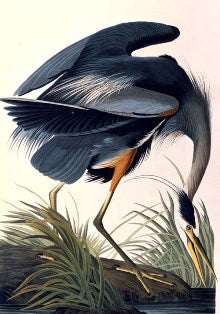 |
| Ä¢¹½Av's "Blue Heron" |
In 1827, John James Ä¢¹½Av painted a rattlesnake attacking a mockingbird nest. The coiled snake, jaws unhinged, is poised to consume an entire family of mockingbirds. The birds are nearly-human: wings thrown up in alarm, eyes wide, faces impossibly expressive. The image is both one of Ä¢¹½Av’s most effective, viscerally seizing attention, but also among his most criticized. Naturalists rebuked Ä¢¹½Av for its abundant inaccuracies and questioned whether Ä¢¹½Av could have ever encountered this scene in the wild.
The painting was just one of the works discussed in “Ģ¹½Av’s Art & Legacy,â€� a panel conversation at the National Arts Club in New York City moderated by Ä¢¹½Av President David Yarnold. The event brought together three distinct perspectives on John James Ä¢¹½Av’s work: Robert Peck, a historian at the Academy of Natural Science in Philadelphia; Jonathan Rosen, a writer and birder; and Walton Ford, a renowned American painter.
The conversation opened with an honest appraisal of the man behind the legend: Ford referred to John James Ä¢¹½Av as a “liar and egotistâ€� and the picture that emerged of Ä¢¹½Av was not altogether flattering. Peck noted Ä¢¹½Av’s pecuniary motives and social insecurities. Rosen acknowledged Ä¢¹½Av’s marital infidelities.
Ford observed how Ä¢¹½Av didn’t merely shoot for specimens; Ä¢¹½Av could be cruel, wounding animals for target practice. Yet Ford—for whom paging through Ä¢¹½Av’s folios was a formative artistic experience—also acknowledged his subsequent fascination with Ä¢¹½Av’s violence. Ford’s paintings have been reacting to and revising Ä¢¹½Av’s throughout his career, probing at the human assumptions behind animal portraiture.
Ä¢¹½Av was a hunter who loved his quarry. His paintings, Rosen remarked, are resurrections. He shot birds, posed them, then painted them in ways that re-imagined and embellished their natural state. These images captivated audiences in a way that no conventional scientific illustration could. While scientific drawings were technically accurate and intensely literal, Ä¢¹½Av’s work was more emotional. His writings and paintings are more akin to the tall-tale tradition of the pioneers, a role that suited Ä¢¹½Av as a groundbreaker and explorer.
The panel also debunked the notion that a conservationist “agendaâ€� could be imposed upon an artist. Ford in particular recoiled at the thought of being assigned to create propaganda, no matter how noble the cause. Nonetheless, Ä¢¹½Av’s written and visual work subsequently inspired many. Just as birds are often our first encounter with a truly wild animal, Ä¢¹½Av’s books introduced thousands to America’s wildlife. His paintings adorned walls and sat on every bookshelf. Peck recounted how on the other side of the Atlantic, a young Scotsman named John Muir was so inspired by Ä¢¹½Av’s writing that he decided to travel to America. Muir become one of the most important proponents of national parks in our nation’s history. Founder of the Sierra Club, he was primarily responsible for protecting Yosemite and thousands of acres of forest.
In the end, Ä¢¹½Av’s art transcended the man’s personal limitations. “He used wilderness to sell his art,â€� Rosen said. “We use his art to sell wilderness.â€� Ä¢¹½Av’s obsession with his subject shines through his work. The popularity and reach of his paintings coupled with their strange, wild qualities have made them lasting and effective messages to millions. An obvious example is the Ä¢¹½Av Society itself, dedicated to conservation and inspired by John James Ä¢¹½Av’s love of nature. His art connected more people than ever before to birds and enforced a crucial recognition of their wildness.
In many ways, the tensions in Ä¢¹½Av’s paintings explain their power. His mockingbirds are moving because they are more human than bird. They teach us to look for ourselves in our fellow creatures. Their combination of creativity and destruction pack a powerful conservation punch, reminding us of our own impulses and our responsibility to the planet.
“Ģ¹½Av’s Art & Legacy: A Conversation,â€� was held January 23, 2012 at The National Arts Club in New York City. The event was organized by the Ä¢¹½Av, Ä¢¹½Av New York, Ä¢¹½Av Pennsylvania, and Alexander Zagoreos in part to support the John James Ä¢¹½Av Center at Mill Grove.
